

Arabic Lesson 5
Check your answers to Lesson 4

This is Lesson 5
You can find the earlier lessons here:


At the end of the last lesson you were asked to find all the words in that lesson derived from the root letters:
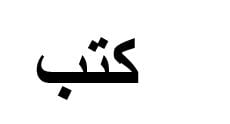
Watch the video to see how to write and say these words:
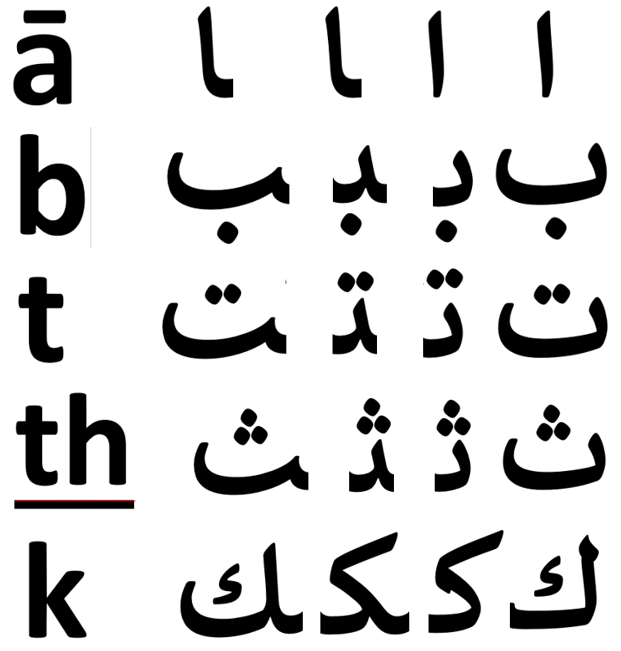
Before we introduce some new letters, let’s recap all the Arabic letters covered to date, in the order of the Arabic alphabet, which is not the same as the order they were introduced in this course.
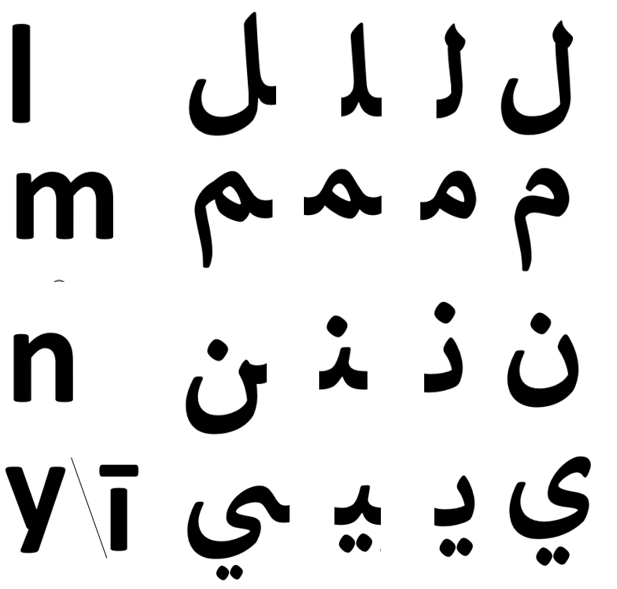
The column on the left in the table below contains the English equivalent according to a convention which allows accurate identification of Arabic letters, not all of which have direct English equivalents.
The bar over the ā indicates it is a long vowel, which is where the stress mostly falls in words. This first letter, called alif in Arabic, is a non-connector, that is, it cannot be joined to a following letter. That is why it has only two possible forms.
The last letter, Arabic Y, has two possible pronunciations, as a consonant, and as a long vowel like the ‘ee’ in feet.
The first column on the right shows isolated forms, that is, not joined to any other letter.
Moving leftwards: the initial form, that is, connected only to a following letter, middle form, connected before and after, and final form, connected only to a preceding letter.
Not included in the table is the weird half-letter hamza ء (see Lesson 3).

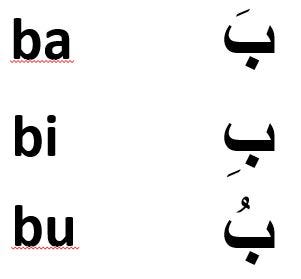
There are three short vowels: a as in hat; i as in hit; and u as in put. They are written as signs above or below consonants to show the following vowel, as in these examples:
A sign like a small zero (sukoon in Arabic) above a letter
means it has no following vowel.
So
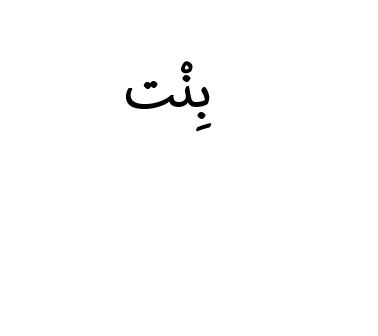
…is bint rather than binat or binit or binut.
Our first new letter in this lesson is Arabic F:
One other new letter, Arabic H:
For practice, translate and write in Arabic:
She wrote the book in my office
He didn’t understand the (female) writer
To extend your listening comprehension of spoken Arabic, imagine you are writing English subtitles for the scene below in a greengrocer’s shop. You may not know all the words you hear but try to guess from the context what they mean, and if possible arrive at a meaning for each word or phrase. Don’t forget to repeat the words out loud in Arabic as well.
Check your answers next lesson.